How To Install Modules Slax
Welcome to LinuxQuestions.org, a friendly and active Linux Community.You are currently viewing LQ as a guest. By joining our community you will have the ability to post topics, receive our newsletter, use the advanced search, subscribe to threads and access many other special features. Registration is quick, simple and absolutely free.
Slax Os
Today!Note that registered members see fewer ads, and ContentLink is completely disabled once you log in.Are you new to LinuxQuestions.org? Visit the following links: If you have any problems with the registration process or your account login, please. If you need to reset your password,.Having a problem logging in? Please visit to clear all LQ-related cookies. Introduction to Linux - A Hands on GuideThis guide was created as an overview of the Linux Operating System, geared toward new users as an exploration tour and getting started guide, with exercises at the end of each chapter.For more advanced trainees it can be a desktop reference, and a collection of the base knowledge needed to proceed with system and network administration. This book contains many real life examples derived from the author's experience as a Linux system and network administrator, trainer and consultant. They hope these examples will help you to get a better understanding of the Linux system and that you feel encouraged to try out things on your own.to receive this Complete Guide absolutely free.
Halo 1 cd key generator download. Hi Fellow Slackers.Long time no see. I'm sorry if I may sound condescending but Slax is not Slackware. Although Slax is,(or possibly was - I'm not sure), derived from Slackware - your questions have nothing at all to do with Slackware itself. In short this forum is to discuss problems with Slackware and not one of it's many derivatives of which there are many. You would be better posting to the with questions on this. Please don't take offence at my response but there have been many posts here about Slax which should be posted to a Slax forum.
Although your question isn't specifically about slackware, slackware is however the perfect tool for this job, especially slackware 12.2 as slax is mostly based on this version. In addition to the tgz2lzm tool mentioned above, there is also the dir2lzm tool.This is actually very useful as you can install a package to a directory, then go into that directory and remove unneeded documentation, man pages, language files etc. Before converting to a module, thus significantly reducing the size. This also has the side effect of making the module load quicker and appear more responsive.The method I prefer is to use slackware for all the heavy lifting, then copy that directory to a usb stick (I use an ext2 formatted stick, but I think vfat also works if there are no symbolic links). Then you plug the usb stick into a computer running slax and issue the commanddir2lzm somedirectory somename.lzmAs you say you should also check dependencies to be sure.Once you have your module, you can put it in the modules folder. However if you have many modules, you should put the rarely used ones into the options folder, then you only load them when needed.As to including proprietary stuff, you should consult with the free software foundation (or a lawyer) for advice.rrbert.
Hi rrbertThanks for the hints.As for your experiences with LiveDistros, would you say that a Slackware Based Live is more responsive than a Debian Based one or an Arch based one.?I'm not much of a user of stuff. But the main lines of my choices are:I will have to install big packages, OpenFOAM, BRLCAD, Code Aster, Dakota, etc, so. The tinier and more barebone is my minimal system, the more likely it is to fit everything into a DVD.Do modules in Slax load preserving stuff like $LDLIBRARYPATH, and $PATH so that if i type. I'm not very knowledgeable about many distros, just slackware and slax. There are variants of knoppix designed to be easily customized, so I guess that would ease access to the rather large debian software repository.On the other hand, if the package doesn't exist in the right version, you might have problems.
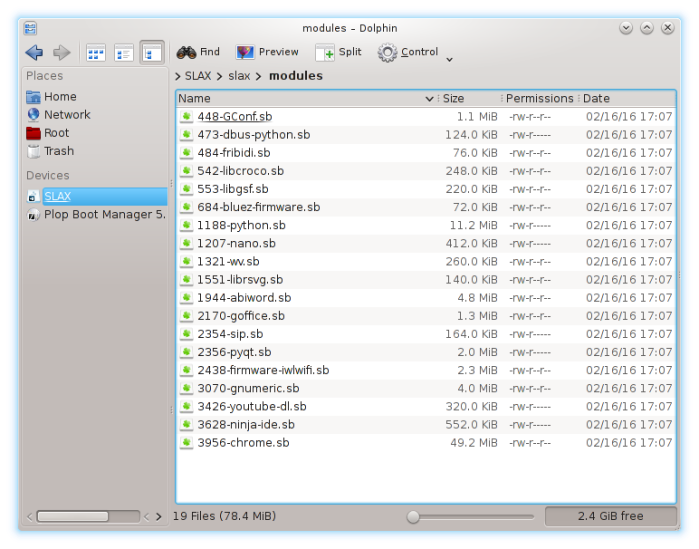
Contents.Features One of the main benefits of the Slax distribution is its ease of customization. Additional software can be added and removed, using Slax modules. A traditional such as Debian's is not required to load additional software; Slax modules are completely self-contained. However, APT is fully supported. Users can also modify the default CD image or USB drive installation to customize the packages available in the distribution on boot. Slax also allows Debian packages to be converted into Slax modules.Slax modules are compressed read-only images that are compressed with a compressor.
The various modules are stacked together to build the complete Slax. A supplemental writable layer (a file system) is put on the top of the stack to implement the write functionality.The stackable file system of choice changed between Slax versions 5 and 6 , as did the module file name extension (changed from.mo to.sb).Versions The Slax releases before Slax 3 were known as 'Slackware-Live'.The latest version of Slax is 9.9.1. Slax 5 There were five editions of Slax 5:. Slax Standard was the standard edition for normal personal use. Slax KillBill included, and to run and applications. Slax Server supplied additional Internet functionality and came with pre-configured, and servers and several other server applications.
Slax Popcorn was a minimalistic edition focused on browsing and multimedia playback. It featured as the default and the lightweight as a instead of. Slax Frodo was a 'bare bones' edition, providing only a full-featured text-only environment, particularly focused on computers with small amounts of RAM.The was an option in all editions except Frodo. Slax 6 Slax 6 is offered in a single version and completely relies on modules (additional packages) for extra features. From version 6, modules are based on LZMA compression, but some compatibility was initially provided between the obsolete.mo modules used by Slax version 5 and the more recent.lzm modules of version 6. As there have been some changes between Linux kernel versions during sub-version releases of Slax 6, however, the.mo modules of Slax 5 are now considered obsolete.
Each module or package should be compiled for compatibility with the Linux kernel currently in use. Slax 7 Slax version 7 was announced on the developer's blog (which has now been integrated into a newly refreshed Slax website). Slax 7 supports both 64-bit and 32-bit architectures, and according to its download page, 'is available in more than 50 languages'.
It also features a stripped down version of KDE 4, a new wallpaper, and a new module system. Slax 9 In November 2017, the developer announced the release of version 9.
How To Install Modules Slax Windows 7
This latest edition is heavily rewritten and is based on, and relies on APT to add packages. The default builds (both 32-bit and 64-bit) contain Fluxbox window manager with a terminal, web browser, LeafPad text editor, calculator, pcmanfm file manager, and wicd network manager. See also.References.